Nature of Shadow
I’ve been thinking lately about the nature of a shadow. The other day I went for a walk, and the sun was blindingly bright, as it tends to be atop these picturesque Romanian mountains. My contrasting shadow was faithfully walking beside me on the path, perfectly reflecting my motion, albeit in 2-D. Although you couldn’t see color, or the increasingly wrinkly details of my face, I think my friends would recognize it was me. The angle of the sun and mountain had elongated my already long legs, making me look more like gumby, or for the kids out there, elasta-girl?
I forgot, I actually took some photos.

What is a shadow, really? I hadn’t really thought about it before, at least too deeply. I haven’t had time this year to think about much of anything this year except some family emergencies, relocation and transition. Life has this way of swallowing us up, doesn’t it?
Like many of us, we employ the concept of shadows metaphorically, even integrating them into our spiritual analogies. Psychology speaks of the shadow (false or pseudo) self. Philosophy is chalked full of shadowy references. Scripture is surprisingly full of shadowy metaphors.
Every good and perfect gift is from above, coming down from the Father of the heavenly lights, who does not change like shifting shadows.
James 1:17-18
For a moment, let’s think about what a shadow is, technically, literally. Firstly, a shadow assumes a few properties are in play, namely light, an object, and a surface that captures the interactivity of both. In the simplest of terms, a shadow is a dark area or shape that is formed when an object blocks the passage of light. I like the word silhouette, which is produced upon a surface of some kind, reflecting the real substance of the obstructing object. We all know what a shadow is when we see it.
I asked some friends earlier this week a question that I’ll turn your way, “Is your shadow, you?” Let that question marinate.
The debate between what is real, and perceived, true and false, substance and shadow has captured humanities curiosity throughout the centuries, with records stretching back to the Pre-Socratics.1 Plato’s’ analogy of the cave2 has been used for 2,000 years to illustrate his theory of forms, and the nature of reality. It’s really quite fascinating, and will assist us in bringing a rather shadowy topic to light.
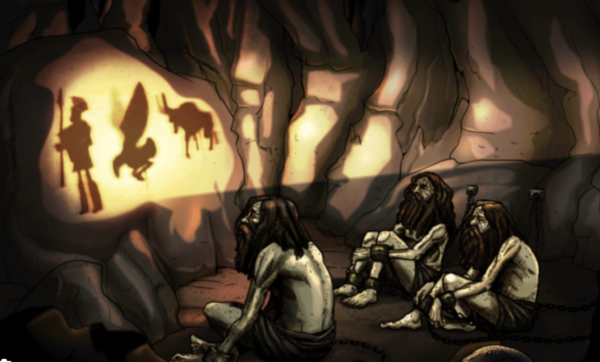
Plato describes a group of prisoners, chained together in a cave since birth, facing a wall, and unable to turn around. Light penetrates the cave from a fire somewhere behind the prisoners, casting shadows upon the wall like a movie screen. At times, objects appear on the wall, which are in fact instruments of varying shapes and sizes held by men, sort of like puppeteers, and they make noises to go along with the shapes on the wall. Yeah, it’s all a little strange. But stay with me.
The prisoners eventually ascribe names, categories, and come to an understanding in their own way what these darkened silhouettes are. They become real to the prisoners, as the constant affirmation of the categories and characteristics frame a certain reality for the prisoners. Of course, we must bear in mind that the prisoners aren’t aware of the nature of a shadow, because there’s a wall behind them which blocks the light. So we have to bear in mind the prisoners might not even know innately what a shadow is!
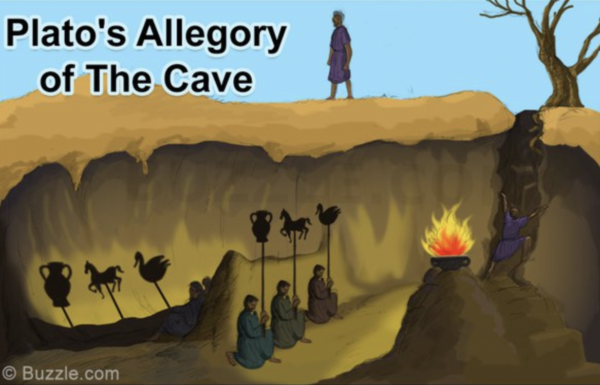
One day, a prisoner is miraculously freed, and escapes the cave, entering the light of the world. The prisoner can’t believe it! His mind is awakened to an entirely new ontology, or reality. He comes to understand that those things displayed on the cave wall were in fact shadows of entirely new substances in this ‘out of cave’ reality. Their names they contrived, wrong. The noises animals make, quite different. As the prisoner, who is initially blinded by the light and contemplates returning eventualy experiences three-dimensional clarity, brand new mental models emerge. He was awakened, enlightened, to the reality of the substance, and it was much more than the shadow! He feels now compelled to go tell his friends in the cave!
Well, as the story goes, the prisoners aren’t interested in leaving the cave. The freed prisoner tries deperately to explain his experience, but the prisoners prefer the shadows, ridicule and even become hostile towards the liberated prisoner.
Nature of Substance
The early church was situated within a Greek and Roman culture that was privy to such stories and deep philosophical debates. Much of the early church writings, including the first Church Councils3, then, wrestled around the idea of Christ’s real nature, or “substance” (Gr. Ουσία). Who was Jesus, really? Was this Jewish carpenter turned Rabbi a reflection of some divine Being, or was he truly the substance of the Divine Being in the flesh? If the latter, how could that be remotely possible!?
The answers to those questions remain at the heart of Christianity itself, and yet, I wonder if we’ve lost the heart of this question?
What if the material world around us, is, in reality, a shadow? What if Plato’s anaology was accurate, and all of humanity is imprisoned, adapted to embracing shadows in pseudo forms, categories, and human made isms? What if the material, measured, physical world is concurrently existing alongside the invisible, and perhaps primary substantial reality?
I’m not suggesting Gnostic dualism here, or, that the material world doesn’t matter (no pun intended). For Christians, the enfleshing of God in the Person of Jesus blows that idea apart. God deeply cares about this physical reality, uniting in his very flesh both ontologies. What if the presently (to us) invisible world of cosmic dimension, a reality all too magnificent for us finite measurers to imagine presently, is the object creating the sillouette before our human experience? Could the beauty and the suffering, the creativity and destruction playing upon the canvas of our limited, temporal state have us bewildered, hook-winked into substituting the substance for the shadow?
In short, what if our respective culture’s set of values and norms are but shadows, and the substance of life lies outside of the cave? Plato would say yes, this is true. Perhaps Russell Crowe had it backwards when his Gladiator character uttered the famous line, “Brothers, what we do in life… echoes in eternity.” What if the opposite is true (also?). What if eternity is the place from which our forms are received, where our concepts of beauty arise? This would explain the brokenness of humanity, and our inept capacity to steward the gift of creation; our reception of the image has been damaged, to say the least.
Emerging from Shadow
Scripture has some really surprising things to say about shadows and substance, and some things sound quite close to what Plato was getting at, with a few (important) exceptions.
In referencing believers relationship to the Jewish many laws and commandments, the Apostle Paul writes:
Therefore no one is to act as your judge in regard to food or drink or in respect to a festival or a new moon or a Sabbath day… things which are a mere shadow of what is to come; but the substance belongs to Christ.
Col 2:17-18
Paul is saying, “Look you Jewish and Gentile believers, let’s use the analogy of the shadow. The commandments? Shadows. Various sacrifices? Shadows. Man-made required religious activity? Shadows. Where should the believers focus be? On the substance, the source of all Light, Jesus Christ the son of God” The New Testament is full of histories shadows, from Israel’s emancipation from slavery, to tabernacle, and sacrificial system.. shadows, which point towards, reference, and reflect and invite now a world to consider substance behind the shadow, Christ!
This may sound strange, like the freed prisoner returning to describe the world outside of the cave, but for the Christ follower, it’s Jesus who holds the present material world together, which is only something the Divine Creator can do.
He himself is before all things, and in him all things hold together.
Col 1:17
There’s a slight problem with Plato’s anaology we must point out. In it, he proposes that the it’s the wise philosopher that becomes self aware, enlightened, exits the cave and in Messiah-like return comes back to free the masses from their ignorance. Plato didn’t think much of himself, it seems! If Plato had just known that 400 years later, the true Light of the World, the one that defied death to prove his substance, would come and bring hope to a world in need of rescuing. You were onto something, Plato. So close!
Don’t let anyone capture you with empty philosophies and high-sounding nonsense that come from human thinking and from the spiritual powers of this world, rather than from Christ. For in Christ lives all the fullness of God in a human body. Col 2:8-10
Col 2:8-10
The narrative of scripture reveals Jesus, the eternal Son, piercing an impossible chasm of limitless eternity, hunching down into his creation. There, Christ becomes a prisoner, you could say, even shackling himself along with us.
Though he was God, he did not think of equality with God as something to cling to. Instead, he gave up his divine privileges; he took the humble.
Phil 2:6 NLT
Through the Gospels we can read of Jesus time in the cave, his actions, stories, miracles, and witness as the Son of God. Thankfully, we don’t need to study philosophy to experience the inner awakening towards life’s all-consuming reality. What we do need, is something that baffles the wise, confounds the world within the cave.. just a little faith. (Insert just a few bars of George Michael’s hit for effect. I always wanted to be able to grow his shadowy beard, but alas.).
Faith as Substance
For reasons too lofty for my tiny brain, Creator God has decided that faith, that deep trust of the heart of you and I, is the key to unlocking the shackles of ignorance, and living into the substance, the reality that is. No amount of logic, of advanced human intelligence can connect our souls with the divine in the way that faith is designed to accomplish. It’s a mystery, it’s crazy good news, and our choice to activate once we hear about the life behind the veil, the Father’s deep love toward’s us all.
The Spirit of God, who raised Jesus from the dead, lives in you. And just as God raised Christ Jesus from the dead, he will give life to your mortal bodies by this same Spirit living within you Romans 6:10-11
Romans 6:10-11
That if you confess with your mouth, “Jesus is Lord,” and believe in your heart that God raised him from the dead, you will be saved.
Romans 10:9-10
Jesus gives, we receive, if we believe. This lavish offering of salvation is free invitation from the original Substance, who happens to be the Person of our Triune Creator. The Father, Son, and Spirit are united in their love, and desire fo us all to be freed from our self-imposed shackles, ignorance, and shame. After all, this Jesus, is Love. The Father sent the Son to rescue us all from a misery of our own making, and restore us to full living, one that lives into this one and the next.
He is patient with you, not wanting anyone to perish, but everyone to come to repentance.
2 Pet 3:9
As tempting as it is to stay among the brokeness of the crowd, to embrace all that we know, and what we can confidently measure or control, inwardly, aren’t we all longing for divine interception?

Faith embraces an ontologically different reality from this world, and sees shadow for what it is. Faith allows shadow to redirect to the genuine substance. Shadow is not where we place our trust or where we feed our souls. The shadows are designed to awaken us to the enlivening experience of salvation in the Person of Jesus. Whether it be the realities of war, or the beauty of a sunset, when we take time to pause, to reflect, to stop, we engage with the potential of the Substance behind the shadow, who is in all of reality (see PanENtheism= God IN all things vs PANtheism=God being all things). I’m sensing, as I age, an increasing of awareness to the many invitations to look behind the veil, to be lured beyond the materially known, the temporary shadow to see, AND EXPERIENCE the Designer through the design.
I’ve spent too long staring at gadgets, allowing my mind to be shaped by the plethora of shadows that bombard visually. I don’t know about you, but my soul is never refreshed from things that don’t lead me to the mystery that made me.
Now faith is the substance of things hoped for, the evidence of things not seen… By faith we understand that the worlds were framed by the word of God, so that the things which are seen were not made of things which are visible.
Hebrews 11:1-6
I would be remiss if I didn’t mentioned faith’s capacity to help us endure difficulty as well, to suffer illness, loss, even persecution from the masses. Salvation for us mortals is still filled with the continued effects of the cave. While many of us may suffer hardship, and even outwardly not have the freedoms others are enjoying presently, the secret of inner freedom allows participation in the substance ahead of time! This is dynamic of connectivity with the Divine, who lives concurrently, simultaneously, in all of reality, not just the one we see in. We are already free within the eternal realities that govern reality itself. It’s like we’ve been given an appetizer before the main course, and it both satisfies and points towards the coming feast.
Though outwardly we are wasting away, yet inwardly we are being renewed day by day. For our light and momentary troubles are achieving for us an eternal glory that far outweighs them all. So we fix our eyes not on what is seen, but on what is unseen.
2 Cor 4:16
Closing Word
I remember as a younger man, I read the life of Jim Eliot. His brief life and ministry to the Auca Indians in Ecuador inspired man, including me. He wrote, “Eternity shall be at once a great eye-opener and a great mouth-shutter.” As I’ve considered the nature of shadow, of substance, and the inner sense within us to plunge realities outside of this temporal one, I think Jim was right. Thankfully, before our mouths-shutter, our kind Creator came through the veil, entered the cave, and promises to be with us, even until the end of the age.
Tis’ better to shutter now, to believe and willingly follow the Savior out from the darkness, into the light, than it will be when Christ returns. There’s something about living into eternity now, presently, that I think will have enduring meaning for each of us. But, I can’t say that is my motivation. I simply want more of the goodness I’ve already experienced in this life, because the more I experience my Creator’s love, the more free I’m becoming from my old false, and incoherent ways of being.
That the name of Jesus every knee should bow, of those in heaven, and of those on earth, and of those under the earth, 11 and that every tongue should confess that Jesus Christ is Lord, to the glory of God the Father.
Phil 2:10-11
Footnotes:
(1) Parmenides (c. 515-450 BCE): held the view that change and multiplicity were illusory and that only "Being" or "Reality" truly existed. He argued that change, such as the alternation between light and shadow, was an illusion because it implied a lack of being or existence.

Heraclitus (c. 535-475 BCE): the ever-changing nature of reality can be related to the shifting interplay of light and shadow in the perceptual world.

(2) Plato’s Cave can be found in his Book VII of The Republic.

(3)First Council of Nicaea (325 CE), First Council of Constantinople (381 CE), Council of Ephesus (431 CE) each dealth with the nature or substance of reality in the Person of Christ, and the Holy Spirit.
Bruce & Deborah Crowe live with four of their eight children in Romania. They’ve spent the last 15 years in Ukraine serving as missionaries, mentors and charity directors. Bruce is working on his doctorate at Fuller Seminary, and Deb is a certified Spiritual Director. You can learn about their life and ministry on this site or by visting www.mirministries.org or by visiting their new Spiritual Direction page at https://sacredformation.com/