We would love to raise $4,000 both locally and among our missional friends for our area’s first wheel-chair accessible bathroom for our +90 special needs kids!
Let’s make culture together – the kind that arrives when Jesus kingdom shows up. To donate, simply click and give from our RazomGo website – thank you for your generosity, it means a lot not only for the kids and their families but our community as well to feel the love from outside Ukraine!
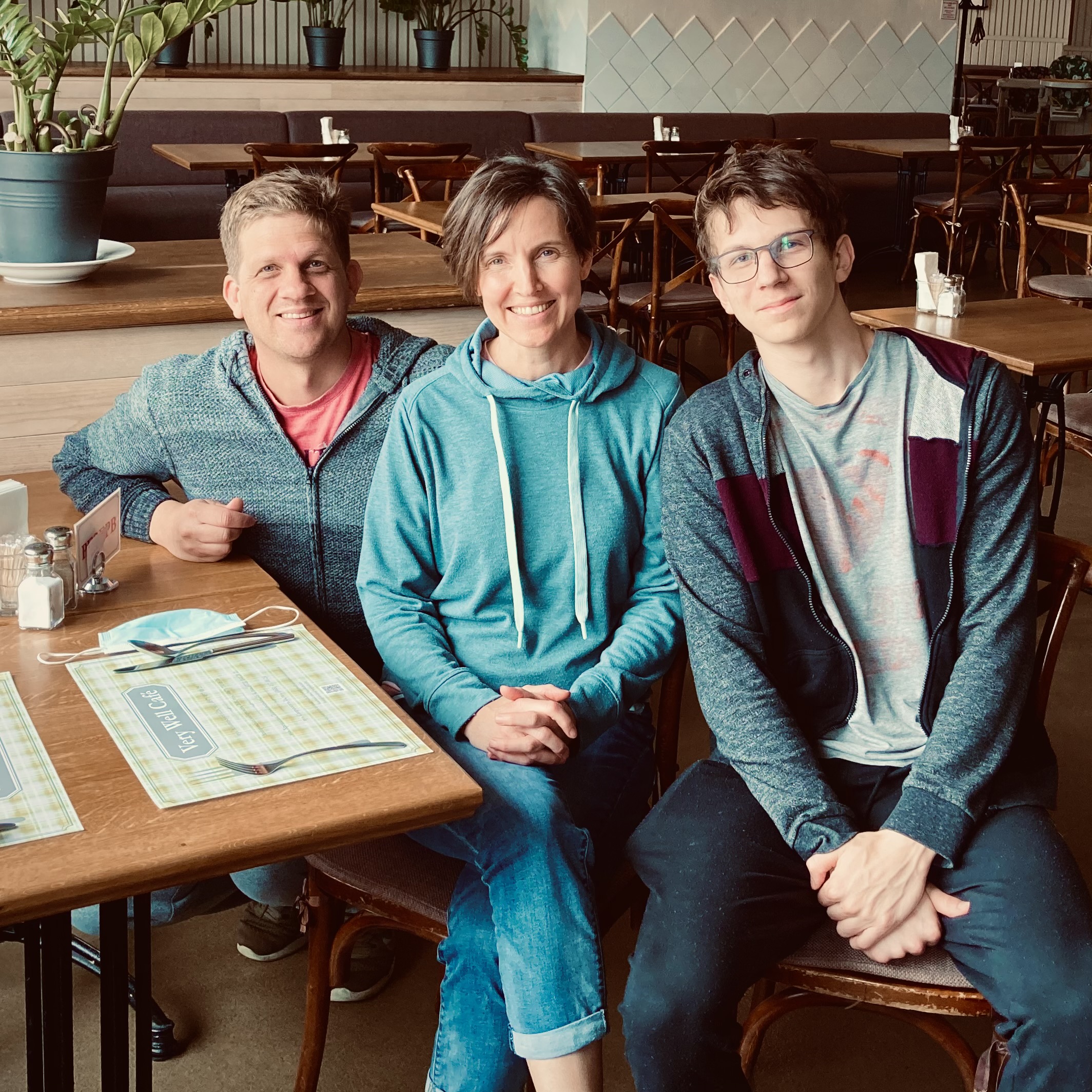
Tucker (18yrs) is off to the US/Canada for the next 5 months. A goodbye lunch.
Insert Boyz to Men.. “It’s so hard, to say goodbye, to yesterday.”
For some odd reason, it doesn’t seem to be getting easier to say goodbye to our young adults. When we moved to Ukraine in 2008, we had six children under 11yrs of age. The thought of saying goodbye and seeing them transition into new forms of independence was a distant future. We knew it would come, just unaware of how quickly it pounces upon you. That distant future, is now! How did it get here so quickly?
Tucker, our #4, is off again to Canada for the summer to work (hopefully) on our family farm. He flew out this morning. Before that can happen, he’ll need to land in Buffalo, get a fresh covid test, then attempt to cross over at Niagara Falls. The chances of him getting in, though he should legally be allowed to enter, Vegas has it at 50% with the government’s excessive fear campaign. If denied entry, he’ll be on an even more exciting adventure as he gets to decide whether to visit his sister in PA, or his brothers in FL, or as Tucker said, “Maybe I’ll just settle in Buffalo for the summer.”
Tucker is unlike any of our other kids. We parents can say that about all our children, of course. So diverse, so unique, God has such a marvelous way of weaving us together in our person. He’s a lot like his mama, reserved, quiet, present. He’s a good listener, he doesn’t seek attention. When Brent left last year, we wondered how the other pea in the pod would do. They were so close, growing up in the same room, and often the same bed as large families go. It’s been cool to see him develop, to spread his own wings, and begin navigating his next steps.
Early years in Ukraine. The week Noah fell out of the van. Tucker far side orange shirt. Broderic, Bronwyn, and Brent all in the US now. Our grocery bill is one decrease we rejoice in.
He’s a creative talent. When he started into graphic design, I thought at first, “Oh no, here’s an industry that will not be kind.” With design, like singing, you either have it, or you don’t. Tucker dove into learning photoshop and different tools, reading books on design, and really applied himself over the past few years. The results are really impressive – he’s got a real knack for typography, and visual design. He’s designed coffee shop logos, several US/Canada and Ukraine projects including billboards. Ok, enough plugging my son, I just want everyone to know he designs for food if he shows up at your door!
Though Tucker is the tallest in our family, at a whopping 6’5 or so, he’s still our little Tucky. I can see his little smirk, not wanting to show his emotion but his joy radiating through. He’s a joy to have around, and we will miss him this summer. I think I miss him already, because I know he’s transitioning, a new season emerging for him, and more transition for us back home. The ebb and flow of adaptive growth. Great, now another song, Elton John Lion King… come sing with me, “the cir——cle…..”
I was thinking the other day, how families indeed are always a state of flux. We think of first having kids, then they grow up, get married and have kids on their own – yet I’ve often thought of these stages as set fixed categories that happen in sequence, as if when you are ready, you push a button.. “Ok, kids are finished, let’s start a new season!” The reality is, they all take place in a family, especially large ones, simultaneously, overlapping one another. While some kids are losing their teeth, others getting their license, and then one decides to get married. Wait, hold up, but I’m not ready! That’s the point, there is no ‘ready’ for new things, only trust and moving ahead.
Life can only be understood backwards; but it must be lived forwards.
Soren Kierkegaard
Our younger kids don’t know what it’s like to welcome a new sibling into the family, the change that brings, the adjustments of a new baby and family dynamics of growth. They only know departure, the change of becoming less in number, and the dynamics of decrease. Watching Tucker leave today, I thought of our family, half as large, different, not better or worse, but transitioning none the less. Whether single, married with or without kids, these life movements are real. Formation, as a favorite 2nd century Christian writer said, is not just our means, but God’s design for humanity, a continual shaping and reshaping, learning and unlearning, as we surrender into new seasons and likeness to God.
The two youngest, Abigail (8) and Claire (6.. and a half she will remind you!).
As we age, now grandparents, it’s definitely becoming more challenging to be so far away, oceans apart from our heritage. Most families struggle to see their kids go off to college, perhaps a city or maybe state away. They have the luxury of welcoming kids back at breaks, at Christmas, and major family events. I smile when I see friends still near their older kids. It does make me miss ours all the more. These are the sacrifices we feel, and feeling afresh as our kids leave and begin their journey, so far, each around 18.
It’s hard, we can feel the personal growth taking place in our own hearts as much as theirs as they step out and trust God, and themselves to navigate new territory. Tucker hasn’t ever checked into a hotel by himself, or ordered his own Uber in the US. He’ll do those things in the next 24hrs, and he’ll be fine. He’ll begin to discover more about himself – I pray that each of our kids sense the nearness of their God, the Father that is keenly aware of their situations.
Our kids do leave home, but a greater journey begins for each of them, as we’ve all experienced. Slowly, over time, we believers find our home in God. We find our wisdom and explore with the Spirit of God. This planet is filled with opportunities for hearing His voice, and being fed by His hands, leaning increasingly on His provision and less on our limited capacities. This brings me joy, and a certain motivation to pray for them all the more. Lord be with Tucker, be with all our kids out there navigating this complex world. Light us up as families that journey together, for one another.
Thinking of those families we know that have said goodbye to their kids on this of eternity. My heart goes out to those will have to wait a lot longer than 6 months or a few years to see their children. Life is truly a gift, undeserved, a grace we can see more clearly as we age. Now I need to go hug someone.
” Great spirituality is about letting go. Instead we have made it about taking in, attaining, performing, winning and succeeding. Spirituality has become a show we perform for ourselves, which God does not need. True spirituality mirrors the paradox of life itself. It trains us in both detachment and attachment, detachment from the passing, so we can attach to the substantial.”
Richard Rohr
To dominate, is to acquire and maintain. To grow in power, in this world, is to gain things like prestige, money, and success. When we think of power, we often think of a domination in its coercive forms. The powerful leaders in history haven’t all be so nice, some downright evil. Accruing resources for personal influence, rule and dominance. For a little while. What sheer chaos and suffering has come from the whims of those in power throughout history!
I wonder, does God dominate? If there is a God, and this God is the Creator of the universe, he must have some immense, cosmic, other-worldly form of power! What defines this power of this Creator? We are witnesses to this power through revealed material creation. We can touch a tender flower, gaze upon the gentle sunset, or listen to the crashing waves. This Creator has used power in a creative way, providing context for life and human flourishing. Power, for God, doesn’t seem to be an expression of might, as much as something that flows from His essence. He created a good place, a life-sustaining place. At minimum, we have to say Creator is creative, and uses power for human flourishing.
The world, as we know it, according to Christianity, is not as it should be. A fallen humanity uses its own forms of god-like power to seek its own justifiable end. We want, we take. If we can’t have, we design our lives in such a way to attain, or die trying. We wield resources to our own self-seeking ends, and if we make progress on our vertical journey, we often end up oppress others in our wake en route. We humans enjoy power, we want more of it. After all, who wants to be without power and the mobility if provides us? Who would sign up to be helpless, immobile, without options and completely at the mercy of another?
We’re going somewhere. Think with me!
What is the opposite of power? Is it weakness? I’m not so sure. Power, when viewed through the lens of Christ, is the capacity to use one’s resources for the ultimate value; love. God uses His creative, limitless power to showcase His nature. In Jesus, we see that God is not nervous about losing power, or becoming weak in the world’s economy. In Jesus we see God empty Himself of divine expression into material, measurable form. He takes on flesh, becomes a first-century Jewish baby, then boy, and grows into an adult male. At the peak of his natural human strength, God, in Jesus, empties Himself once again, this time through the most powerful act humanity has witnessed. If God hasn’t clearly shown humanity that power is love in the act of the incarnation itself, He triumphs in the display of the eternal Son hanging on a Roman torture instrument.
God uses power to suffer, divest of His resources, to save us from ourselves.
This is power in weakness. Weakness at least in the world’s understanding. Suffering, divesting love, pouring out for the other; this is God’s demonstration of the highest use of power. In Jesus, God is revealing His perfect nature, clearly, undeniably. We want to look away, we would rather have God thunder like Zeus, dominating the cosmos with an iron fist. We take comfort in our forms of power, we identify with them, but they are broken and beneath God. We want to look away from this power, for us it’s foolish, weak, and invites us to look deeply into our own clinging, our own fear of letting go. This life is all we have, if God risks, if God is ultimately relational, if God is Jesus and Jesus is God, it’s the dominant Zeus that must die.
I’ve often thought, so many believers would rather an omnipotent, but evil God ruling the universe than a suffering but morally beautiful Deity. What does this say about us as humans? What does it say about our fear of the realities of the incarnation and the Cross? We must let God define Himself, and live into the consequences of this reality – there is no other reality if Christ indeed was God, and Christ indeed is alive still.
Those who cling to this world and its coercive structures of power and unending hierarchies of success, have exchanged God’s power for something beneath us, a broken reflection of our image. It’s beneath us, because it’s a reflection of Satan’s realm, and not be in the DNA of a follower of Jesus. We humans rattle around on this earth longing for more, grabbing on, clinging to such illusions. We’ve failed to see Christ, we keep looking down and missing the Son lifted up. Think of the invitation Creator has offered us? To participate in His power, to enjoy eternal life, to receive His gift of love, to know His resurrection power!
When the world and it’s illusions infiltrate our Christian spaces, we’re in trouble. The world won’t encourage us to let go, or to truly love. It redefines power, love and success. It will conspire to woo us into it’s dead-end pursuits, it’s passions for security, safety, and self-reliance. Love is the most violent, selfless expression we can experience, and the most spiritual as Rohr so aptly quotes above.
To lay down our lives and participate in God’s power, is to use what ever resources and influence we have to share in God’s restoration project. Power is a gift, a gift for human flourishing, a gift for bringing the loving reign of Jesus to earth as it is in heaven. The power of God is the Gospel, and the Gospel is Jesus the person, His life and all that it has revealed for humanity. Power, in the life of the believer, is to let go of preservation mentality, of visions of self aggrandizing, and to empty ourselves like Christ for the world. True power is not dominance, nor oppression. True love is liberation from the systems of this world. It’s seeing Jesus before Pilate, the Creator of this world subjecting Himself to our ignorance and scorn. True power is restrained judgment, believing and trusting God’s goodness. Power is displayed on the Cross when Creator God let’s go of needing to be understood, popular or safe. Use what gifts, talents and capacities you have to serve the other and become like Christ, participating in God’s power.
This world is broken, but it’s not without hope. As long as there are believers who take up their cross, identify themselves with the loving way of the Father, there is salt, light, and hope for our generation. Love cuts through the noise, the garbage narratives, and propaganda of our age. Our battle is not to win arguments, but to to love our neighbor. As long as we cling for affirmation, and worldly forms of power, we will continue wandering this planet in search of meaning and never experiencing the power of love’s transformation. We’ll never be the church in our generation unless we have God’s highest, most flourishing kind of power. This power is received dear friend, by letting go, the Apostle Paul likens it to dying. It’s a paradox of power, that in death, we find life. Dominance brings destruction, love wins.
For whoever wants to save their life will lose it, but whoever loses their life for me will find it.
For Fuller seminary course on Eastern Orthodox Theology, I had to document my experience. Here is what I wrote.
St. Micheal’s Cathedral, Kyiv
On Sunday, May 16th, I visited St. Michael’s Orthodox Church in Kyiv, Ukraine. This was my first Orthodox liturgy service, and I was initially quite nervous driving up to the beautiful monastery grounds. I arrived 20 minutes early for the service, and immediately found myself a little lost among the network of stairs, and multiple church looking buildings. As I approached what looked to be one of the original church buildings, I still wasn’t sure I was in the place. There were several individuals gathered by the entrance, so I held my breath and walked inside like I belonged there!
Inside the smaller, museum Church building.
I was disappointed to see a line of people gathered around what looked like a tourist-like convenience store along the wall of this historic building. They were buying candles for the most part, but there were many other icons, and items for sale. I skipped the line, wondering where the service was? I soon realized that I wasn’t in the right church! I was in the original St. Michael’s building from the 11th Century, which had been restored a few times from fires and war, still revealing ancient icons on stone and brick walls. I highlight this because even though I wasn’t participating in a liturgy yet, I had plenty of time to enjoy the detail in the icons, and stations which included a number of very old looking relics. One particular station was lit with a dozen or so candles, displaying Christ on the hill of Golgotha.
Being in the confines of a much smaller, more intimate setting of the original church, I was able to pay attention to the believers as they worked around the various stations. I was noticing the ways in which they crossed themselves, some once, some three times. Some walked through briskly, as if they were completing an easy test, while others lingered for ten minutes, and seemed to be sincerely praying.
Though I’ve never really understood the lighting of the candles, and was initially unimpressed with the commercial aspect of churches selling them simultaneously inside the buildings, I experienced, I think, the Spirit of God at one of the stations. As I stared, mesmerized by the candles, I considered that each candle did in fact represent a living soul, valuable and made in the image of God. I felt a connection to them, their ongoing prayer, heard and bringing about action in the heaven-lies. How many prayers have been offered here? Over how many centuries? I was thankful for this moment as the Spirit encouraged me that my prayers are not over necessarily when I think they are over, but echo in the eternal heart of our loving Father.
Inside the main ‘Nave’ area.
As I left the functional museum, for lack of a better word, I then approached the massive, golden domed Church of St. Michael’s. I felt more confident entering this colossal structure after having spent time in the little Church. I was ready for the continuous crossing gestures, and visual feast that was awaiting me. This time, I was definitely in the right place. You could hear angelic, perfectly pitched harmonies, in minors floating across the entire landscape as you approached the building. At first, I honestly thought there were speakers somewhere, but after searching for them, realized these gorgeous sounds were coming from the church itself, one high definition speaker!
I was determined to get in without being noticed, but that was next to impossible. As I walked in the church, I entered directly into the nave. The magnificently detailed and wooden framed iconostasis was directly to my left, and the Priest was chanting something and holding a large Bible. The Word of God proceeding from eternity, through the barrier of material reality, and into the world of Creation. I had some catching up to do, and was late!
As I looked for the safest place to stand, I worked my way to the back of the Church, and the music was even louder. The choir, on the second story balcony, were out of sight, and I could barely count ten of them. Yet, the magnificent sounds flooded every inch of the cathedral. Where were they all hiding? Can this sound be coming from only a handful of voices? It was refreshing to think that the Orthodox singers were serving the Church, truly, not performing in front of it.
This area has a monastery and area I found some manuscripts on display.
For the first twenty minutes, I honestly don’t remember what was taking place at the front, because I was engaged in looking at the massive murals and trying to isolate particulars within many gospel stories. There was Lazarus to my right, and Christ the infant holding a scroll on the lap of the Theotokos. The visuals, combined with the surround sound angelic choir, worth the price of admission! I engaged in a few crossing gestures throughout the service, but found liberty to just open my hands, close my eyes at times, and feel my feelings.
Occasionally I could hear someone near me singing along, but for the most part, the choir engulfed all the voices. About half way through, I began to pick up on more of the liturgy. The iconostasis was at times hiding us onlookers from what was taking place in the back. Doors opening, declarations, and chantings intermittently left me wondering, as a simple onlooker, what are they doing back there that could be taking so long? The Eucharist, as I’ve learned, is being prepared, the central event which will culminate eventually in the invitation breaking through the eternal hidden realms, into concrete material reality for the Church, in the Person of Jesus Christ and His life, death and resurrection were clearly central to the service.
Finally, after a lot of singing, and a short sermon-like encouragement from a much younger man dressed in black, the Priest and his helpers, who were dressed in red and white, presented the bread and wine. Because of Covid, I can only assume, the wine was dispensed to each person on a napkin, which the believer would quickly touch with their lips, or suck in an effort to consume some of it. It was a strange site! The children went first, and then adults, but I would estimate only 30% of the crowd actually took communion. It was over fairly quickly.
After the Eucharist, an offering box was passed around, and almost everyone gave a monetary gift of some kind. It was the one familiar part of the service for this foreigner, everyone needs money! After this, another priest came out with a bucket of water, and what looked like a small wooden whip. I backed up, because I’ve seen this take place in my home town along our river at different events. The priest very liberally doused the congregants with water, spraying it in many different directions and chanting something I didn’t understand. There were a few smiles among some ladies that received a double portion!
Before everyone exited the building, I noticed a young man kneeling in the corner, by a statue of a small cross. He remained kneeling for quite some time. When he stood to his feet, he dried his eyes quickly, and left. It touched me. He has been obviously repenting, or deeply moved in a time of prayer that was sincere and heartfelt. I was encouraged to see this, because with all of the external focus on visuals and sounds, I was honestly curious who was being present and not simply outwardly performing rituals. This man was encountering God through his posture, his prayer, his emotions, and it seemed to breathe a fresh wind of hope in my perspective towards Ukrainians long and difficult heritage.
I really enjoyed my first liturgy. I recognize that to engaged the service more deeply, that I need to read over a full liturgical service in English. I also would like to attend a Russian Orthodox service, which I still have my reservations about. The Ukrainian service felt bright, the illuminated building, the bright priestly clothing, even a few smiling faces! I was anticipating more of a dirge-vibe, a somber procession of rituals, but there was surprising hope and enough continuity in my own faith to feel welcome in this other-worldly place.